

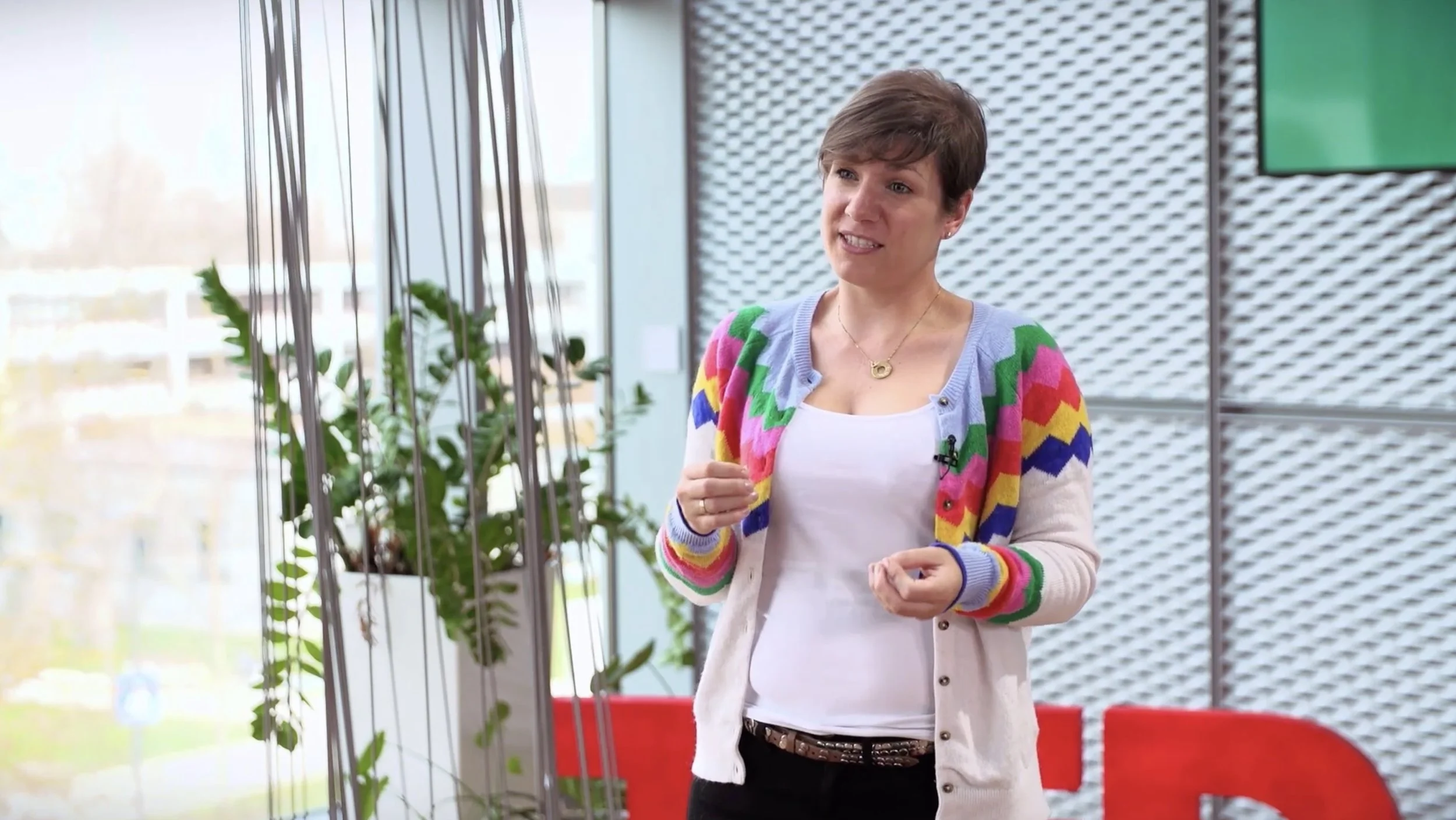
TEDxTUM 2021 – Talk „Why our current satellites aren't as smart as you think"
The TEDx event was cancelled.
We were still dealing with the effects of a global pandemic. The incidence rates were moving. Rules around meetings and gathering, number of people in a room, required testing, face masks moved with it. Until one week before the recording date, none of the speakers knew whether the studio session would go ahead.
Well, it did. Recording: 9 April 2021.
Publication on the TED platform: 15 June 2021. This is how "Why our current satellites aren't as smart as you think" ended up as a recorded TEDxTUM Studio talk instead of a stage one. I am admiring until this day how flexible the TEDx team was in their preparation, organisation and decision making.
The teaser image of my talk is a flying toaster.
Satellites are marvelous, sophisticated machines orbiting planetary bodies. They are also (at least at that time, that feels like ages ago) operated like the toaster on your kitchen counter: with constant human supervision. A problem onboard, and the spacecraft stops its scientific operation and waits. On the ground, an operator manually works through thousands of parameters, procedures and lists to figure out what happened. If the problem persists, the spacecraft joins in worst case the ever-expanding space junkyard.
The reason onboard intelligence stays primitive is a hard engineering constraint, plus a little lack of ambition in a conservative industry. Space-graded hardware has to survive radiation and extreme temperatures, and that puts qualified components years behind consumer-grade silicon. You cannot ship a model to orbit the way you ship one to a phone. Meanwhile, the number of spacecraft in orbit was set to triple within five years, with mega-constellations hundreds strong on the roadmap.
That was the shape of the gap: hardware ambition sprinting, operator interfaces stuck.
Three takeaways from the talk
1. The bottleneck sits at the operator interface, not the spacecraft.
The impressive layer is in orbit. The primitive layer is a human on the ground, parsing parameter lists in a spreadsheet. Autonomy that is buildable in the short term lives at the interface, not on the payload. If you invest in one side, the ground side pays back faster.
2. The engineering constraint forces the intelligence elsewhere.
Radiation and thermal environment are non-negotiable. Space-graded hardware trails consumer hardware by years and will keep trailing for structural reasons. The design consequence is straightforward: put the intelligence where the constraint does not apply. On the ground. In the tooling. In the data infrastructure the operator sees every day.
3. Scale is what makes the manual layer break.
Manual operator supervision worked for tens of satellites. It stops working at thousands. The toaster analogy is only funny while the constellation is small. Mega-constellations of hundreds of satellites turn a workflow annoyance into a mission-cost problem measured in operator working hours.
Sounds familiar, just like the breaking of the human-in-the-loop-principle of AI agents in 2026, doesn’t it…?
Why watch it now
The talk is 14 minutes long. It holds up because the engineering constraints are explained without jargon and without shortcuts. The mechanism stays intact for a non-space audience.
The framing also travels beyond spacecraft. Highly capable systems held back by the layer between them and their operator is a pattern I have seen in autonomous vehicles, in autonomous trains, and now in enterprise agentic AI. Different domain each time. Same shape.
Five years on, I run the Responsible AI Office at ZEISS. The through-line is the same one I argued in the talk: the trustworthy layer of a system is the unglamorous one. Data infrastructure. Scalable “operator” tooling. Human-in-the-loop design. It is where trust gets engineered in, or where it gets missed.
Which of your toaster problems, sophisticated systems held back by spreadsheet tooling, are the most expensive right now?
Watch the talk
Alexandra Wander: Why our current satellites aren't as smart as you think — TEDxTUMStudio.
Recorded 9 April 2021, published 15 June 2021.